Learning credit assignment
Chan Li,Haiping Huang. (2020). "Learning credit assignment." Physical Review Letters.
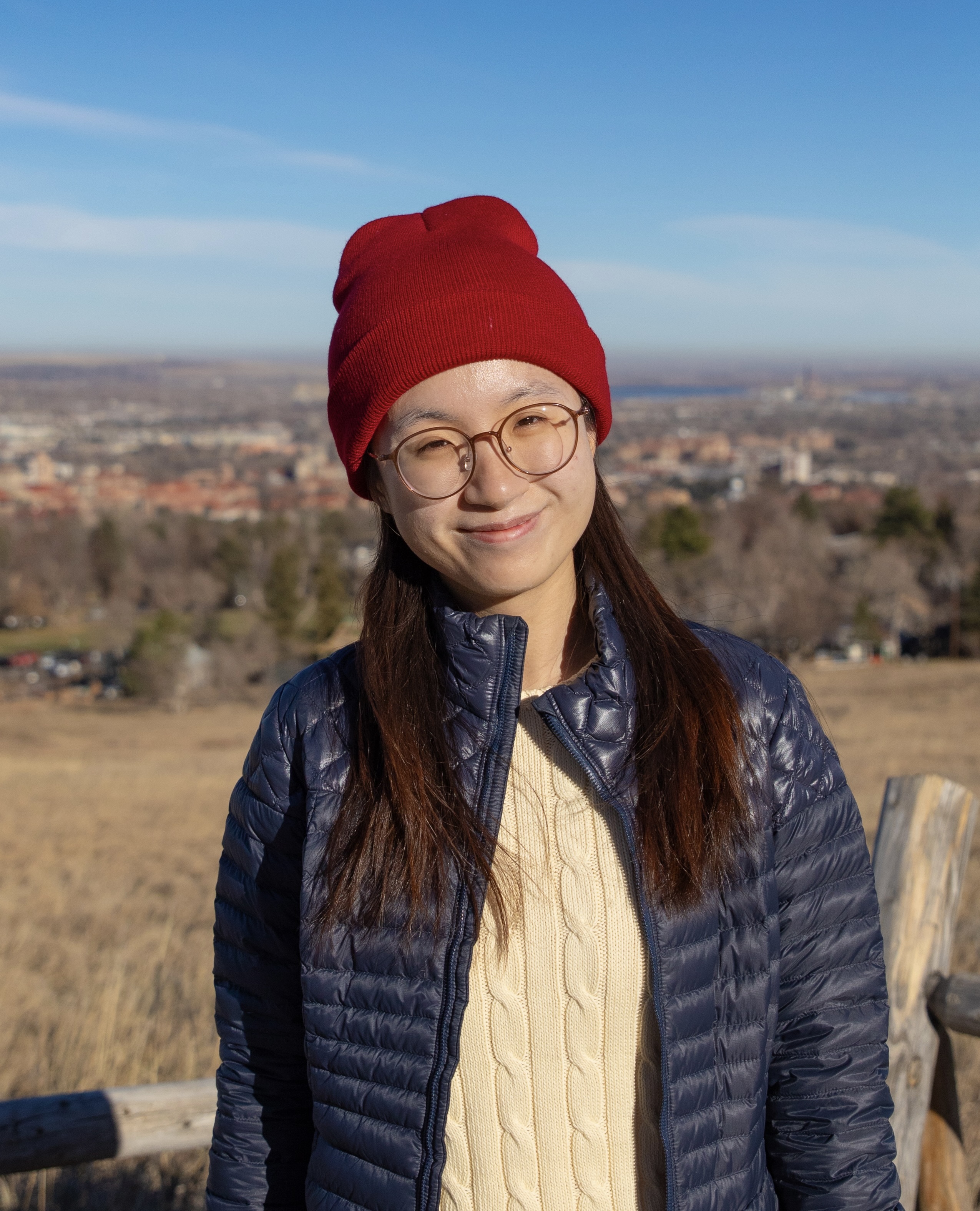
Visa Status: F-1
Private email: chan.li.physics@gmail.com
Phone: +1-858-370-9516
Ph.D. Student in Theoretical Physics, University of California San Diego (2023–present)
Scheduled to advance to Ph.D. candidacy in December 2025.
Address: Room 7258, Urey Hall, University of California San Diego,
Department of Physics, 9500 Gilman Drive, La Jolla, CA 92093, USA
Professional email: chanli@ucsd.edu
University of California San Diego (UCSD) — La Jolla, USA
Ph.D. in Physics (anticipated June 2028)
Advancement to candidacy scheduled December 2025; GPA: 3.96/4.0
September 2023 – Present
Sun Yat-sen University — Guangzhou, China
M.Sc. in Theoretical Physics, GPA: 89/100 (3.55/4.0)
August 2020 – June 2023
Sun Yat-sen University — Guangzhou, China
B.Sc. in Optoelectronic Information Science and Engineering, GPA: 88/100 (3.78/4.0)
August 2016 – June 2020
Graduate Student Researcher — University of California San Diego
Spring 2024 – Present
Supervisor: Prof. Nigel Goldenfeld
Teaching Assistant — University of California San Diego
Winter 2024
Supervisor: Dr. Jessica Arlett
Ph.D. Researcher in Physics | Advisor: Prof. Nigel Goldenfeld
Project 1: Learning Dynamics and Scaling Behaviors in Large Neural Networks (Oct 2024 – Oct 2025)
Developed physics-inspired models to explain robust generalization in overparameterized neural networks, informing scalable and reliable AI design.
Under review at Physical Review Letters (top-tier peer-reviewed journal).
Project 2: Learning Algorithms for Emergent Symmetry Discovery in Physical Systems (Apr 2025 – Present)
Designed learning algorithms to identify hidden symmetries and invariant structures from physical data.
Combined theoretical analysis with data-driven modeling to enhance interpretability. (Manuscript in preparation.)
Researcher in PMI Lab | Advisor: Prof. Haiping Huang
Project 1: Interpretable Learning Framework for Neural Networks (Aug 2019 – Oct 2021)
Developed probabilistic and mean-field learning models explaining how deep and recurrent neural networks coordinate parameters.
Published in Phys. Rev. Lett. 125, 178301 (2020) and Phys. Rev. E 107, 024307 (2023).
Project 2: Hierarchical Representations in Deep Learning (Aug 2021 – Oct 2022)
Designed algorithms decomposing neural network weights into interpretable latent modes.
Published in Phys. Rev. Research 5, L022011 (2023).
Project 3: Continual and Multi-Task Learning Frameworks (Aug 2020 – Oct 2022)
Developed physics-inspired frameworks mitigating catastrophic forgetting and enhancing knowledge transfer.
Published in Phys. Rev. E 108, 014309 (2023).
Project 4: Predictive Coding Models for Language Processing (Apr 2023 – Apr 2024)
Implemented predictive coding models to study information flow and adaptive learning in neural circuits.
Published in Phys. Rev. E 109, 044309 (2024).
Programming and Software:
Proficient in Python for machine learning, scientific computing, and data analysis;
experienced with PyTorch, NumPy, SciPy, and Matplotlib;
familiar with C/C++, Linux, and LaTeX; working knowledge of Matlab and Mathematica.
Machine Learning and Optimization:
Designing and training neural networks, implementing optimization algorithms (SGD, Adam), and analyzing training dynamics, generalization, and scaling behaviors.
Statistical and Probabilistic Modeling:
Strong foundation in statistical physics, Bayesian inference, and probabilistic modeling, including mean-field and random matrix analysis.
Communication:
Effective in cross-disciplinary collaboration and clear presentation of complex technical ideas across physics, computer science, and applied mathematics.
Languages:
Native in Chinese; fluent in English (IELTS 7.5).
Chan Li,Haiping Huang. (2020). "Learning credit assignment." Physical Review Letters.
Wenxuan Zou1,*, Chan Li1,*, and Haiping Huang. (2023). "Ensemble perspective for understanding temporal credit assignment." Physical Review E.
Chan Li,Haiping Huang. (2023). "Emergence of hierarchical modes from deep learning." Physical Review Research.
Chan Li1,*, Zhenye Huang2,*, Wenxuan Zou1,*, and Haiping Huang. (2023). "Statistical mechanics of continual learning: Variational principle and mean-field potential." Physical Review E.
Chan Li1 and Haiping Huang. (2024). "Meta predictive learning model of languages in neural circuits." Physical Review E.
posters at Chinese National Conference on computational and cognitive neuroscience, 2021 online, online
posters at Chinese National Conference on statistical physics and complex systems, 2021 in Changchun, China (1st Prize for poster), Changchun, China
Talk at APS March Meeting 2025, Anaheim, Los Angeles, California